
This section presents case studies demonstrating the application of the Regio1st tools in supporting regional energy planning. For some tools, multiple examples from different countries are included to highlight their adaptability and impact across diverse local contexts.
Context & Use
The FAEN applied the National and Regional Targets Comparison Template Tool as part of the development process for the upcoming regional renewable gases strategy or action plan. The tool was employed in the early stages to update and consolidate the existing regulatory and legislative frameworks related to renewable gases. This included mapping current laws, identifying gaps, and aligning regional goals with national and EU-level targets.
Outcomes & Reflections
By utilizing the National and Regional Targets Comparison Template Tool, FAEN was able to ensure that the emerging strategy for renewable gases is grounded in a clear understanding of applicable policies. The structured mapping allowed for better coherence and identification of policy overlaps or missing elements. It also facilitated communication among institutions and aligned the regional strategy with broader sustainability and decarbonization goals. Additionally, this tool is used as a reference to assess and confirm whether the regional objectives are realistic and achievable considering the possibilities of the region.
Overall, the National and Regional Targets Comparison Template Tool proved to be a key enabler in the strategic planning process.

Context & Use
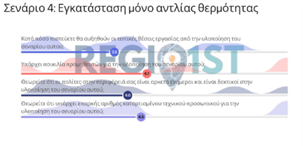
The Participatory Priorities Ranking (PPR) Tool was piloted in Western Macedonia, Greece, during a hybrid regional workshop hosted by the Cluster of Bioeconomy and Environment (CluBE). More than 35 participants joined, including representatives from local and regional authorities, stakeholder organizations, and civil society. The regional authority and planners identified five key priorities (Energy Efficiency, Just Transition, Regional and Local Development, Protection of the Environment and Biodiversity, and Climate Adaptation) while stakeholders assessed them using the tool’s structured multi-criteria methodology. Using the PPR Tool’s structured multi-criteria approach, participants assessed these priorities through an interactive platform (Mentimeter), which allowed for real-time voting and lively discussion. The session achieved broad consensus, with all priorities ranking highly. This highlighted a shared commitment to sustainable energy planning and ensured the results reflected both policy goals and community perspectives.
Outcomes & Reflections
The first application of the PPR tool in Western Macedonia highlighted its usability, adaptability, and capacity to generate consensus across diverse stakeholders. The results showed that all priorities (especially Energy Efficiency) were strongly supported, confirming alignment between EU energy policies and local needs. By actively involving participants, the process strengthened ownership of the outcomes, enhancing both the legitimacy and inclusiveness of regional planning. Some challenges also emerged: participants needed more awareness of the “Energy Efficiency First” principle and greater familiarity with participatory methods and digital tools. Even so, the workshop showed how online platforms can broaden participation and improve representativeness.
Overall, the PPR Tool proved to be an effective bridge between high-level policy and the realities of regional development.

Context & Use
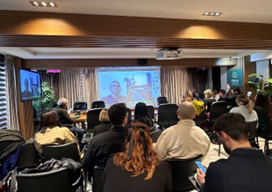
The Technology Catalogue Tool was studied by the Regio1st local partners and shared with our stakeholders during the middle phase of the Regio1st project. However, since the Regional Energy and Environment Plan of Liguria Region (PEAR) is a strategic document that does not provide details about technologies, we could not directly use the tool for the process. Specifically, while the Plan clearly indicates percentages for saving and producing energy, it does not tell how to achieve them (e.g. the technology to use and its location).
Context & Use
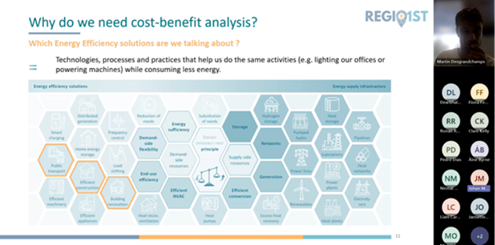
The Technology Catalogue Tool was introduced during a dedicated workshop focused on the Regio1st Cost-Benefit Analysis (CBA) Tool, due to the strong complementarity between the two. The session aimed to support local planners in understanding how to identify optimal energy solutions in line with the Energy Efficiency Directive (EED) recast, and to meet the associated requirements for performing CBA. As part of the workshop, we walked participants through key planning questions such as where CBA applies, how to assess wider benefits, and where to find reliable data before demonstrating how the Technology Catalogue can significantly accelerate the identification and evaluation of viable technical options for both supply and demand-side measures. This was framed in the broader context of energy transition planning, particularly relevant to our region in the South-East.
Outcomes & Reflections
The Technology Catalogue proved to be a valuable time-saving tool for planners and local authorities, particularly in early project design stages. By offering readily available data on costs, efficiencies, and emissions for a wide range of technologies, it allowed participants to benchmark solutions quickly and feed this information directly into the CBA tool. This streamlined what would otherwise be a laborious research process. A key takeaway from the session was the added relevance of the tool when applied to real or upcoming local projects, helping to contextualize the data and make its benefits more tangible. The main challenge was ensuring familiarity with the technical parameters, but this was largely mitigated through guided examples and group discussion. The combination of regulatory framing, practical application, and user-friendly content made for an effective introduction to the tool.
Context & Use
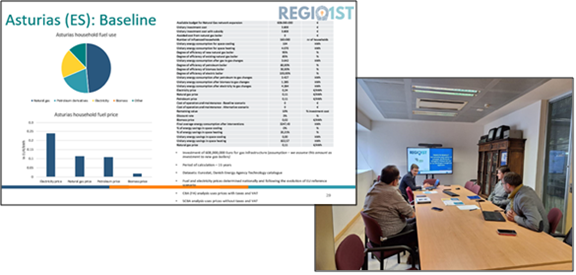
The Cost-Benefit Analysis (CBA) Tool was initially applied using regional data from Asturias, with the aim of assessing the effectiveness and impact of currently implemented energy measures. The results obtained provided valuable insights into the economic and environmental performance of various actions and served as a critical input for the potential revision of the existing Regional Energy Strategy. Following this internal application, the outcomes of the analysis were presented during a dedicated workshop with the Directorate-General for Energy (DG Energy) and relevant policy makers. This session created a forum for reviewing the methodology and discussing the implications of the findings. The tool’s capacity to facilitate evidence-based planning and highlight priority areas was recognized as a strength, and the exchange contributed to refining the strategic outlook for the future revision of the current regional energy strategy.
Outcomes & Reflections
The first application of the CBA Tool using Asturias-specific data yielded several important conclusions. Notably, it enabled the identification of measures with the highest cost-effectiveness and highlighted those with limited impact relative to their investment. This analysis helped establish a clearer prioritization of actions and informed a more data-driven approach to revising the current Regional Energy Strategy. Additionally, the tool facilitated a better understanding of the wider co-benefits associated with certain measures, such as social and environmental gains.
During the workshop held with DG Energy and regional policy makers, the presented results generated strong interest and constructive discussion. Authorities expressed particular interest in applying the CBA Tool to evaluate new measures that may arise during the revision of the strategy. The tool offers the possibility to adapt to the regional and particular data. The session reinforced the tool’s value not only as a compliance instrument aligned with the Energy Efficiency Directive but also as a practical planning aid for informed decision-making and strategic alignment at multiple governance levels.
Context & Use
The Cost-Benefit Analysis (CBA) Tool was introduced to Liguria Region during a dedicated workshop in January 2025.
First, we provided a general overview to contextualize the Tool within the EE1st principle and explain what it is and how it works, considering the multiple impacts on the intervention (not only financial aspects, but social and environmental externalities). This was essential to establish a solid understanding of its relevance and purpose, since the Region was not familiar with using the CBA analysis.
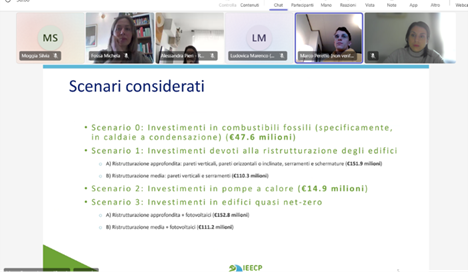
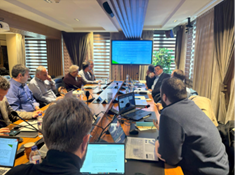
Afterwards, we presented the results of the CBA simulations carried out as part the Regio1st project on their pilot case, explaining the different scenarios considered, the data sources, and what we mean by social and environmental externalities. Below is a picture from the workshop:
At the same time, in May 2025 we introduced the CBA tool to the technical people developing the SECAP for the Municipality of Savona. We tailored the presentation to their specific needs, providing all the main information and explaining them how useful it would be to run some tests in some of plan’s actions.
Outcomes & Reflections
In the case of Liguria Region, when the too was presented the Regional Energy and Environment Plan was already in a too advanced phase (close to final approved) for the CBA analysis to be included in it, but they confirmed their availability to take it into consideration and run some tests in the next phases (e.g. monitoring phase).
As for Savona Municipality, the tool is currently being used to test the SECAP action regarding the Energy Renovation of public buildings. Regio1st’ local partners are working alongside the two technicians developing it to build their capacity to use the tool and run the tests. The Plan is expected to be approved between the end of 2025 and the start of 2026.
Context & Use
The Cost-Benefit Analysis (CBA) Tool was introduced during a dedicated workshop aimed at helping our local authorities in the South-East region align their planning practices with the requirements of the Energy Efficiency Directive (EED) recast. Given the legal obligation to perform CBA for certain energy planning decisions, it was essential to first establish a solid understanding of its purpose and relevance. To make the tool more accessible and adapted to the Irish context, we customized its structure—filtering for relevant technologies, automating data integration to avoid manual copy-pasting, and adding contextual explanations. The tool was then presented through an iterative tutorial, where we guided representatives from housing, energy, and planning departments step by step through its application.
Outcomes & Reflections
The CBA Tool proved to be a powerful enabler for informed decision-making, allowing planners to systematically compare energy options based on costs, savings, and performance under different conditions. Customizing the tool increased its usability significantly and helped foster confidence among local authority staff. Using real-life, grounded project examples ensured relevance and engagement, allowing each department to see direct connections to their ongoing or planned initiatives. A key challenge was demystifying the more technical aspects of the tool, which we addressed through hands-on examples and tailored guidance. Overall, the tool not only supported compliance with the EED but also enhanced our regional local authority’s capacities to evaluate and prioritize robust, cost-effective energy solutions.


Context & Use
The REGIO1st Multi-Criteria Decision Analysis (MCDA) Tool was implemented in the Region of Western Macedonia (Greece) in 2025 through a hybrid workshop organized by the Cluster of Bioeconomy and Environment (CluBE), with the participation of more than 15 representatives from local and regional authorities, academia, and key stakeholders. The session focused on evaluating six alternative scenarios for meeting heating demand in the building sector: business as usual (efficient gas boilers), medium and deep renovation packages, the use of heat pumps, and combinations of renovation with heat pumps and photovoltaics. Using the tool’s TOPSIS-based methodology, participants worked with planners to assess the scenarios against economic, environmental, societal, and feasibility criteria, providing inputs both quantitatively and qualitatively through the interactive Mentimeter online platform. This process ensured that diverse perspectives were integrated into the evaluation, leading to an integrated ranking of options.
Outcomes & Reflections
The application of the MCDA tool in Western Macedonia demonstrated its strength in structuring complex decision-making and considering multiple impacts of energy planning. By combining quantitative data with stakeholder-informed qualitative assessments, the tool provided a transparent and evidence-based way to compare alternative scenarios. Energy-saving interventions such as deep and medium renovation emerged as the top-ranked solutions, reflecting strong alignment with EU climate goals, environmental priorities, and societal needs. Importantly, the participatory approach boosted legitimacy and strengthened stakeholder ownership, ensuring that regional realities were properly incorporated into the results.

Uključivanje načela Energetska učinkovitost na prvom mjestu u regionalno energetsko planiranje
 Sufinancirano sredstvima Europske unije u sklopu projekta br. 101076088. Izneseni stavovi i mišljenja su stavovi i mišljenja autora i ne moraju se podudarati sa stavovima i mišljenjima Europske unije ili CINEA-e. Ni Europska unija ni tijelo koje dodjeljuje potporu ne mogu se smatrati odgovornima za njih.